

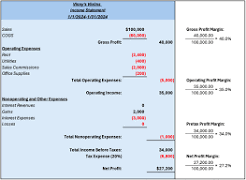
A recommerce business can appear profitable when margin is calculated only as the difference between acquisition price and resale price. If a store buys an item for $70 and sells it for $120, the apparent margin is $50. That number, however, says little about how much money the company keeps after inspection, repair, transport, storage, payment fees, and return risk are included.
The difference between headline margin and economic margin is similar to comparing the visible price of a digital service with the full cost of customer acquisition behind it; even unrelated online products such as online game crazy time exist inside cost structures that are not visible from the transaction alone. In recommerce, this distinction is more important because every unit can require a different amount of work before it becomes sellable.
Start With Contribution Margin, Not Markup
Markup measures how much the selling price exceeds the acquisition cost. It does not measure profit.
If an item costs $60 and sells for $100, the markup on cost is about 67%. But if the business spends another $12 on repair, $8 on logistics, $5 on processing, and $4 on labor, the contribution before overhead falls to $11.
A more useful formula is:
Contribution margin = selling price − acquisition cost − variable processing costs.
Variable processing costs should include every expense caused directly by that unit.
Add the Full Acquisition Cost
The purchase price is only one part of inventory acquisition.
A business may pay collection fees, seller incentives, inbound transport, authentication costs, import charges, marketplace fees, or employee time required to process the purchase.
Suppose an item is acquired for $50, but delivery to the warehouse costs $6 and inspection costs another $4. The real acquisition cost is already $60 before any repair begins.
Ignoring these expenses makes sourcing channels look more profitable than they are.
Treat Repair as a Unit-Level Cost
Repair is one of the main reasons headline margins can be misleading.
Two products purchased for the same price may require different levels of work. One may need only cleaning, while another requires parts, testing, and several hours of labor.
Repair cost should therefore include materials, external service fees, internal labor, replacement parts, testing, and failed repair attempts.
For example, a device bought for $80 may need a $12 replacement component and $10 of technician time. Its effective inventory cost becomes $102 before logistics and sales costs are added.
This is why repair data should be attached to each stock unit rather than averaged only at company level.
Include Logistics in Both Directions
Recommerce often involves more transport stages than standard retail.
An item may travel from the original owner to a collection point, from the collection point to a warehouse, and from the warehouse to the buyer. A return adds another transport stage.
The margin model should therefore distinguish inbound logistics, warehouse transfers, outbound shipping, return shipping, and failed delivery costs.
If a business offers free delivery or free returns, those expenses belong directly in unit economics. They should not be treated as separate marketing costs simply because the customer does not see them.
Account for Processing and Warehouse Labor
Labor can disappear from margin calculations because salaries are often recorded as overhead.
However, some labor is clearly connected to individual inventory units.
Cleaning, grading, photography, listing, packaging, testing, and return inspection all consume employee time. A store can estimate the average number of minutes required for each activity and multiply it by the effective hourly labor cost.
If listing and preparation take 25 minutes and warehouse labor costs $18 per hour, the item carries about $7.50 of preparation labor.
This cost becomes important in categories with low selling prices.
Add Payment and Selling Fees
Every completed transaction may generate payment fees, marketplace commissions, platform charges, or fraud-prevention costs.
A 3% payment fee on a $150 sale removes $4.50 from contribution margin immediately.
Marketplace commissions can have a larger effect. If a third-party sales channel takes 12%, the same $150 transaction creates an $18 expense.
Businesses should therefore calculate margin separately by channel. An item sold through a direct store and the same item sold through an external platform may have very different economics.
Estimate the Expected Cost of Returns
Not every product will be returned, so return cost can be modeled as an expected expense.
If the average return costs $20 and the return rate in a category is 10%, the expected return cost is:
$20 × 10% = $2 per order.
That $2 should be included when forecasting unit economics.
Categories with high return rates may require a larger expected-cost adjustment, especially when returned items lose condition grade or need to be processed again.
Include Markdown and Resale Risk
A product does not always sell at the original listing price.
Inventory may require price reductions after several weeks. Some products may become outdated, damaged, or unsellable.
A margin model can account for this by using expected selling price instead of list price.
For example, if a product is listed at $120 but historical data shows that similar inventory sells for an average of $108 after markdowns, the margin calculation should use $108.
Using list price creates an optimistic view of profitability.
Calculate Margin After All Variable Costs
Consider an item sold for $150.
The business pays $75 to acquire it, $12 for repair, $7 for inbound logistics, $8 for preparation labor, $9 for outbound shipping, $5 in payment fees, and an estimated $3 for expected return cost.
Total variable cost equals $119.
The contribution margin is therefore:
$150 − $119 = $31.
The real contribution margin percentage is:
$31 ÷ $150 × 100 = 20.7%.
This number is far more useful than the apparent $75 difference between buying and selling prices.
Use Real Margin to Guide Sourcing Decisions
Margin analysis should influence which products a recommerce business accepts.
A product with a high resale price may still be unattractive if it has high repair costs, frequent returns, or expensive shipping. Another product with a lower selling price may generate more reliable profit because preparation is simple and inventory turns faster.
The strongest sourcing model therefore uses historical unit economics by category, condition, supplier, repair type, sales channel, and return rate.
Recommerce profitability depends less on the gap between purchase and resale prices than on controlling everything that happens between those two transactions. Real margin becomes visible only when repair, logistics, labor, fees, returns, and markdown risk are treated as part of the cost of each unit.
